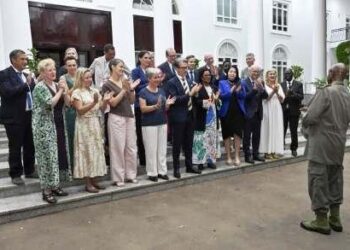









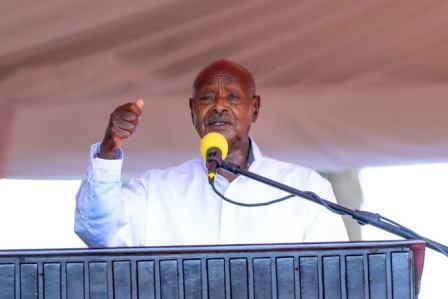
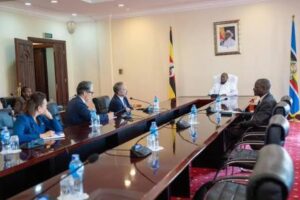
President Yoweri Kaguta Museveni recently welcomed a high-level European Union delegation to State House, Entebbe.
The visitor was Mr. Johan Borgstam, the European Union Special Representative for the Great Lakes Region.
The agenda was regional peace and security.
At the centre of it was the long-running conflict in eastern Democratic Republic of Congo (DRC).
An Envoy With a Regional Mandate
Mr. Borgstam’s job is to keep Europe’s many voices in the region pulling in the same direction.
He has told the President that he was tasked to spearhead implementation of the EU Great Lakes Strategy and to ensure coherence among EU member states in the region.
The EU says that strategy leans on African-led peace efforts, including the Luanda and Nairobi processes and the International Conference on the Great Lakes Region.
Seeking out the region’s leaders is part of how the envoy works.
On an earlier tour, he flew into Entebbe from Bunia in eastern DRC.
“The Only Solution Is Talk”
President Museveni used the meeting to restate a position he has held for years.
He reiterated his call for dialogue and described it as the only viable solution to the conflict in eastern DRC.
“The only solution is talk. Stop all these threats and wars and everything else and talk, because it is unfair that the people of Congo are suffering because of this stubbornness to refuse to talk,” President Museveni said.
His message was blunt, and it was aimed at the humanitarian cost of the fighting.
He argued that ordinary Congolese are paying for the refusal to sit at one table.
Peace by Political Means
The President also spoke about what the Congolese people are owed.
He emphasised that they deserve peace.
He added that they deserve the opportunity to determine their future through peaceful political processes.
In his view, the future of Congo should be decided through politics and not through the barrel of a gun.
“A Regional Father Who Is Wise and Experienced”
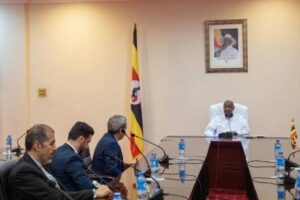
Mr. Borgstam arrived with a request for counsel as much as a diplomatic agenda.
He commended President Museveni for his leadership and experience in regional affairs.
He said the EU delegation had come to seek the President’s guidance on the challenges facing the Great Lakes region.
“We have come to seek your advice and get a full analysis from you as the regional father who is wise and experienced,” he said.
Why Dialogue Is So Contested Right Now
The call for talks comes while several peace tracks are running side by side and none has stopped the fighting.
M23 captured Goma in January 2025 and later took Bukavu, the capital of South Kivu, which dramatically altered the balance of power in eastern DRC.
The Washington Peace Agreement, signed by the DRC and Rwanda on 27th June 2025, includes security commitments on armed groups and the presence of forces in eastern DRC.
Kinshasa accuses Rwanda of supporting AFC/M23, an allegation Kigali denies.
A second, Qatar-led process deals with the Congolese government’s dispute with the AFC-M23 alliance.
The Doha agreement signed in November 2025 sets out commitments on prisoner exchanges, humanitarian access and restoring state authority.
As of August 2026, the DRC government and M23 had agreed on a roadmap for peace talks, without ending the fighting.
Last month, a senior UN official told the Security Council there is a “window of opportunity” for peace, even as the security and humanitarian situation has continued to worsen.
The UN also planned to facilitate a meeting on 18th October in Lusaka between the defence ministers of Burundi, the DRC, Uganda, Rwanda and Tanzania.
The politics inside Congo are moving as well.
President Tshisekedi announced a national dialogue in August but excluded armed groups from it.
This week, an opposition coalition including Martin Fayulu and Moise Katumbi said there is no military solution and called for talks involving all parties.
That makes the President’s plea more than a slogan.
It speaks to the question of who gets a seat at the table.
Uganda’s Place in the Picture
Uganda is not a bystander in this story.
The UPDF has conducted joint operations with the Congolese army in eastern DRC against the ADF since December 2021.
During that earlier tour, the EU envoy expressed appreciation for the UPDF’s work in restoring normalcy in areas where the forces have operated jointly.
In an opinion piece, Mr. Borgstam described Uganda as a pivotal partner in achieving the goals of the EU’s Great Lakes strategy.
He pointed to Uganda’s commitment to regional economic integration and sustainable resource management, as well as its role in peacekeeping.
The Faces in the Room
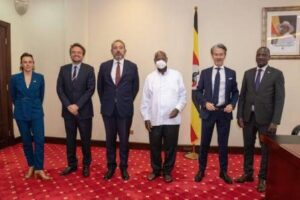
The meeting drew a strong EU team.
H.E. Jan Sadek, the EU Ambassador to Uganda, was present.
H.E. Eole Sury, the Deputy Head of the EU Delegation to Uganda, also attended.
So did Mr. Tristan Terryn, the Political Adviser to the EU Special Representative for the Great Lakes Region.
What Comes Next
The meeting produced no new agreement, but it showed where the conversation stands.
On one side is a European diplomat asking for advice.
On the other is a President who says the answer is simple, even if carrying it out is not: stop the threats, stop the wars, and talk.
Whether the parties in eastern DRC will heed that call is the question that still hangs over the Great Lakes region.