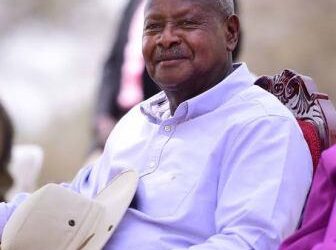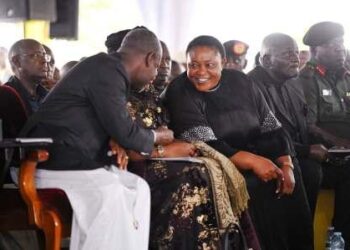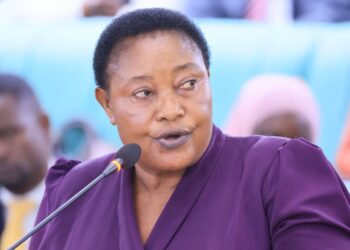













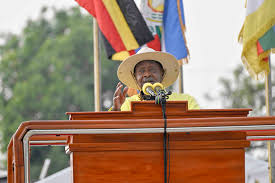
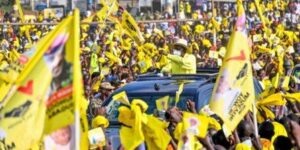
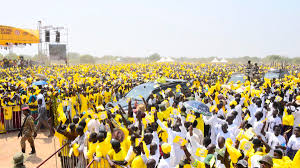
President Yoweri Kaguta Museveni received an enthusiastic welcome at Booma Grounds in Hoima City today, where thousands gathered for his campaign address alongside the First Daughter, Mrs. Natasha Museveni Karugire, and senior National Resistance Movement (NRM) leaders.
He used the rally to present the NRM Manifesto to residents of Hoima District and Hoima City, placing emphasis on the seven core contributions the movement has delivered to Uganda over the last four decades.
He began by asserting that peace remains the fundamental achievement upon which all other national progress rests.

“Thank you for coming in big numbers. I am here with other NRM leaders to present to you the contributions the NRM has put on Uganda for the last 40 years. The first contribution is peace—and that one we don’t need to explain,” he said.
He described peace as the bedrock that allowed the revival of national institutions, the return of economic activity, and the continued stability that has attracted investors to regions such as Bunyoro.
He then shifted to the second pillar—development—explaining that it encompasses both economic and social infrastructure.
He cited the steadily expanding road network across Hoima and the wider Bunyoro sub-region as evidence of this commitment, particularly the strategic road corridors supporting the nascent petroleum industry.
He pointed out that telecommunication coverage has widened, creating new opportunities for digital services and business growth.
He said that the electrification programme has connected 12 out of the 14 Sub-counties and Town Councils in Hoima District, noting that the remaining two—Kiganja and Kijongo—will be connected in the next government term.
He highlighted major social-service investments that continue to reshape education and health outcomes.
Hoima District, he said, now has 64 government primary schools and 6 government secondary schools, while Hoima City has 33 government primary schools and 5 government secondary schools.
He emphasized that all government secondary schools in the district and city offer Universal Secondary Education (USE) and Universal Post-O-Level Education and Training (UPOLET).
He noted that four Seed Secondary Schools under construction will reduce the number of Sub-counties without a government secondary school from eight to four.
In the health sector, he reported that Hoima District currently has 1 Health Centre IV, 9 Health Centre IIIs and 9 Health Centre IIs, with multiple upgrades ongoing.
He said the government plans to elevate Kigorobya Health Centre IV to a General Hospital and construct new Health Centre IIIs in underserved Sub-counties.
He added that Hoima City benefits from Hoima Regional Referral Hospital, which now has a functional CT scan, a new X-ray machine under shipment, four radiologists, a functional ICU with six beds, and a 15-cubic-metre oxygen plant.
He stressed that physical development must be complemented by wealth creation at household level.
“Development is good, but it’s not enough without wealth creation. We have been advising you to stop working only for the stomach but also work for the pocket,” he said.
He advised small landholders to embrace the four-acre model while encouraging large landowners to venture into tea growing, ranching, cotton production and other commercial enterprises.
He underscored that Uganda’s newly discovered petroleum wealth must be managed responsibly.
“In Uganda now we have new wealth—oil. We have confirmed 6.5 billion barrels of crude oil in the Albertine region, and we are still exploring. But some people want us to misuse this money. Oil will only last about 20 years, so we must invest it in long-term projects,” he said.
He assured Bunyoro residents that in addition to the Kabalega Industrial Park dedicated to petroleum-based industries, the government will build a separate industrial park focusing on agro-processing to avoid mixing food industries with petroleum activities.
He noted that job creation will increasingly come from four key sectors—commercial agriculture, factories, services and ICT.
He encouraged youth in Hoima to join skilling centres to acquire employable competencies in trades needed for Uganda’s growing economy.
He commended Bunyoro’s contribution to national growth and reaffirmed his commitment to industrialisation within the region.
Rt. Hon. Anita Annet Among, the NRM Second National Vice Chairperson (Female) and Speaker of Parliament, praised President Museveni for major projects such as Hoima Stadium, Bunyoro University and improved road networks.
She said the President was in Bunyoro not merely to campaign but to celebrate the achievements secured under the NRM.
Prime Minister Rt. Hon. Robinah Nabbanja thanked the President for championing the emancipation of women and pointed to her own rise as the first female Prime Minister from the Bunyoro Sub-region as evidence of the opportunities created under the NRM government.
NRM Vice Chairperson for Western Uganda, Hon. Asiimwe Jonard, applauded mobilisers for securing overwhelming support for the movement and reaffirmed the region’s strong backing for President Museveni.
The NRM District Chairperson for Hoima, Mr. Vincent Muhumuza Savannah, expressed gratitude for major investments such as Hoima International Airport and the Regional Blood Bank.
He raised concerns about widespread land evictions and appealed to the President to help residents access affordable and secure land titles.
The NRM’s Four-Decade Model of Peace, Development and Wealth Creation
Uganda’s political and economic trajectory over the last 40 years has been shaped largely by the NRM’s three-tier transformation strategy.
Peacebuilding formed the earliest priority, as the government focused on stabilising regions that had suffered under conflict and insurgency.
This stability laid the groundwork for economic reforms that liberalised markets, expanded trade and attracted foreign investment.
Infrastructure development has followed a steady upward trajectory, marked by national road networks, universal education programmes, a growing electricity grid and strengthened health services.
The launch of oil production in the Albertine region is expected to accelerate long-term investments, especially through the planned oil refinery, the East African Crude Oil Pipeline and new industrial parks.
Yet, central to the NRM’s philosophy is the belief that national development is incomplete without household wealth creation.
This approach emphasises the four-acre model, enterprise selection, commercial agriculture and youth skilling—strategies aimed at transforming families from subsistence living to income-generating participation in the money economy.
As Uganda prepares to enter its oil era, the intersection of peace, infrastructure growth and household wealth creation remains the guiding framework of the NRM’s development narrative—one President Museveni continues to champion in rallies across the country.