

















Uganda has taken a major step toward building climate-smart and environmentally sustainable farming systems with the launch of the Uganda National Agroforestry Strategy (2024/25–2033/34), an ambitious 10-year framework designed to reshape land use across the country.
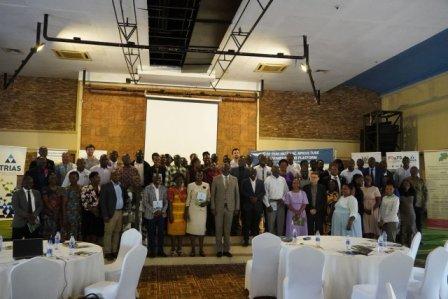
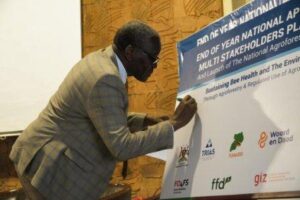
The strategy was unveiled by the Ministry of Water and Environment through the Forest Sector Support Department during the End-of-Year National Apiculture Multi-Stakeholder Platform held at Golf Course Hotel in Kampala.
The event took place under the theme “Sustaining Bee Health & the Environment through Agroforestry and Regulated Use of Agrochemicals,” highlighting the growing link between agricultural production, pollinator protection and environmental sustainability.

Presiding over the launch, the Permanent Secretary of the Ministry of Water and Environment, Dr Alfred Okot Okidi, emphasized that the new strategy offers Uganda a unified roadmap for scaling up agroforestry in all regions.
He stated that integrating trees into farming systems is no longer optional but essential for achieving long-term environmental recovery and improved livelihoods.
He explained that the strategy will guide farmers, policymakers, researchers and conservation partners in restoring degraded landscapes, protecting biodiversity, strengthening climate-resilient agricultural practices and contributing to a greener and more prosperous nation.
He said the government is committed to ensuring that every part of the country benefits from agroforestry innovations.
He noted that the overarching goal of the strategy is to integrate trees into all farming systems to enhance livelihoods, improve ecosystem services and support national climate change mitigation efforts.
He added that Uganda’s agricultural future depends on practices that increase productivity while safeguarding soils, water and biodiversity.
The launch was supported by Wood en Daad, Trias, the Uganda National Apiculture Development Organization (TUNADO) and several other partners actively involved in sustainable land management, forest restoration and pollinator conservation.
The ceremony also brought together beekeepers, environmental experts, civil society actors and development agencies who discussed the crucial role of agroforestry in enhancing bee forage, regulating the use of agrochemicals and building healthier ecosystems.
Participants observed that Uganda’s bee industry relies heavily on natural vegetation, making the adoption of agroforestry—particularly fruit trees, indigenous species and nectar-rich plants—vital for sustaining bee populations and expanding honey production.
Why Agroforestry Is Becoming Central to Uganda’s Agricultural Transformation
Agroforestry has gained momentum globally as a cost-effective tool for balancing agricultural productivity with environmental protection, and Uganda is among the African countries placing it at the heart of national policy.
Uganda’s landscape has undergone decades of deforestation, wetland degradation and soil exhaustion due to rapid population growth, charcoal demand and expanding agriculture.
These trends have placed pressure on farmers, reducing soil fertility, increasing vulnerability to drought and floods, and threatening crop yields.
Agroforestry provides a solution by promoting farming systems where crops, livestock and trees coexist to deliver multiple benefits.
These include improved soil fertility through nitrogen-fixing trees, reduced erosion, increased water retention, diversified income from fruit and timber, improved microclimates and enhanced biodiversity.
Agroforestry also supports Uganda’s commitments under the Paris Agreement, the Bonn Challenge and the Nationally Determined Contributions (NDCs), which outline pathways for reducing emissions and restoring landscapes.
The launch of the National Agroforestry Strategy comes at a time when the government is intensifying climate adaptation efforts, strengthening apiculture value chains and promoting regenerative agriculture as part of Uganda’s broader green-growth agenda.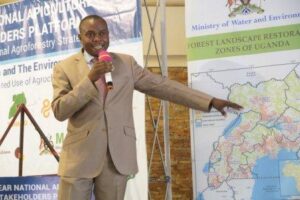
A New Chapter for Farmers and the Environment
With the new strategy now in place, both government agencies and development partners are expected to roll out large-scale training for farmers, distribute appropriate planting materials and strengthen monitoring systems to track agroforestry adoption nationwide.
The Ministry of Water and Environment says the next phase will focus on empowering communities to restore their own landscapes, boosting farm productivity and ensuring that agroforestry becomes a standard practice within Uganda’s agriculture sector.
The launch marks a significant milestone in Uganda’s long-term transition toward sustainable land management and climate-resilient food systems.