

















Ten years ago, the land at Ndibulungi village in Luwero district was little more than wetland grass and scattered gardens.
Today, it hums with canning lines, poultry sheds, and drying racks of chili destined for kitchens in China.
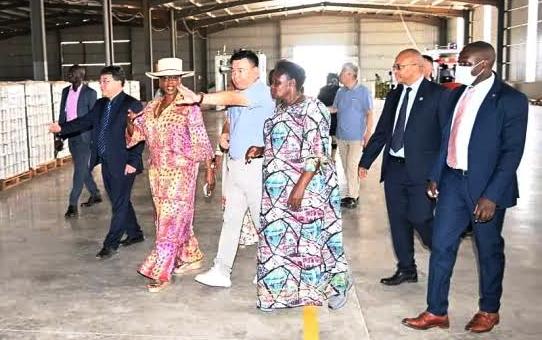
That transformation is what brought Vice President Jessica Alupo to Luwero on Thursday, leading a delegation of senior government officials on an assessment tour of the China-Uganda Agricultural Cooperation Industrial Park.

She left impressed, and she said so in terms that framed the visit as more than ceremonial.
“Today’s visit is a concrete demonstration of Uganda’s commitment to transforming our economy through targeted agro-industrialization,” Alupo said.
“Our strategic goal is clear: to transform our agricultural sector from traditional subsistence practices to commercialized high-value modern agri-business,” she added.
A Decade in the Making
The park Alupo toured did not appear overnight.
It traces back to 2015, when Kehong Group, a private Chinese investment firm, signed a memorandum of understanding with Uganda’s Ministry of Agriculture, Animal Industry and Fisheries committing an initial 220 million US dollars to commercial agriculture, value addition, and job creation on land in Luwero and neighbouring Nakasongola district.
President Yoweri Museveni broke ground on the project in April 2016, describing industrial parks at the time as central to raising farmers’ earnings.
The early years were not without struggle.
Local reporting years into the project described stretches where machinery sat idle and phases of the rice and poultry components lagged behind schedule, a reminder that agro-industrial ambitions of this scale rarely move in a straight line.
What Alupo toured this week is the version of the park that pushed through those growing pains.
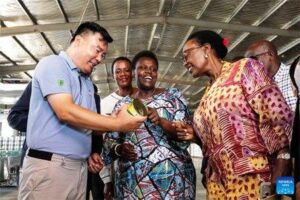
Marking its 10th anniversary this year, the China-Uganda Agricultural Cooperation Industrial Park now runs a pineapple canning factory, a chili processing plant supplying dried chilies to China, and a poultry operation supplying eggs to both domestic and regional markets.
Kehong Group’s subsidiary, Deshiburg Fruits International, only weeks earlier flagged off its first consignment of 140 tonnes of canned pineapples processed inside the park for export, a milestone Uganda’s Agriculture Minister Frank Tumwebaze said increases demand for pineapples as a raw material and finally gives farmers a reliable market for a famously perishable crop.
What Alupo Saw, and Why It Mattered to Her
Alupo did not simply admire finished products.
She commended the FAO-China-Uganda South-South Cooperation initiative, the technical framework under which the Chinese private sector-led park was established, crediting it with enabling Uganda to process agricultural goods for export to the world rather than shipping them out raw.
She pledged that government would keep improving infrastructure and policy support around the park, describing the goal as creating a more enabling environment for agro-industrial investment.
She also pointed to opportunity still on the table.
Uganda, she said, stands to benefit further from China’s continued high-standard opening-up and its zero-tariff policy for eligible exports.
“We look forward to having more related exports by taking advantage of the 100 percent zero tariff policy,” Alupo said.
Luo Heng, chairman of Kehong Uganda Industrial Development Limited, the company managing the park, used the visit to look ahead rather than back.
He said the park’s first development phase, launched in 2016, is now complete, having delivered commercial layer farming, contract chili cultivation, pineapple processing, and the promotion of improved rice varieties.
For its second phase, Luo said Kehong plans to invest 500 million US dollars over the next five years.
The Deeper Story: China’s Long Hand in Uganda’s Farms
The Luwero park is a single site, but it sits inside a much larger pattern of Chinese involvement in Uganda’s agricultural modernisation.
Under the same South-South Cooperation programme, Chinese agronomists helped introduce a high-yielding foxtail millet variety now grown across six Ugandan districts, including Oyam, Lira, Amuria, Budaka, Butaleja, and Luwero itself.
That variety yields roughly 5 tonnes per hectare, compared with about 2.5 tonnes for improved local finger millet and just 1 tonne for traditional varieties, a jump that matters directly for food security in a country where over 80 percent of the population still depends on agriculture for its livelihood.
The park also hosts an Integrated Technology Transfer Base, where Chinese experts test new crops and run demonstrations to build the skills of local farmers in crop production and animal husbandry before those lessons spread to the wider farming community.
None of this exists in isolation from the broader China-Uganda relationship, which has quietly become one of the more consequential economic partnerships either country holds.
Employment has been one of the park’s most tangible local dividends.
At its peak build-out, the Luwero site was providing jobs to more than 1,500 Ugandans, spanning factory floor work, contract farming, and technical roles tied to the poultry and rice components.
That local hiring pattern mirrors a wider argument Ugandan officials have made for years, that Chinese-backed agro-industrial parks succeed only when they pull surrounding smallholder farmers into their supply chains rather than operating as isolated foreign enclaves.
The chili and pineapple components at Luwero were explicitly designed around contract farming, meaning nearby growers supply raw produce to the factory under agreed terms rather than the company running its own plantations alone.
Sixty-Plus Years of a Deepening Partnership
Uganda and China established diplomatic relations on 18th October 1962, just nine days after Uganda’s independence, and the relationship has been built on steadily since.
Chinese investment in Uganda was modest in its earliest form, visible mainly in small restaurants and clinics as far back as 1991, before growing into the manufacturing, energy, and infrastructure footprint visible today.
China has funded or built major national assets including the Kampala-Entebbe Expressway and works at Entebbe International Airport, and it is now widely described as Uganda’s largest single source of foreign direct investment.
Trade between the two countries has climbed accordingly.
Bilateral trade stood at just over 1 billion US dollars in 2017, reached 1.46 billion dollars by 2024, and hit a record 2.1 billion US dollars in 2025, a 43.5 percent jump in a single year.
Uganda’s coffee exports to China alone reached 62 million US dollars in that period, nearly doubling year-on-year, while dried Ugandan chili made its first successful export run to China in January 2026.
In September 2024, the two countries elevated their ties to what officials describe as a comprehensive strategic cooperative partnership, a diplomatic upgrade that followed Uganda’s participation, led by Alupo herself, in the Forum on China-Africa Cooperation summit in Beijing.
Uganda’s Ambassador to China, Oliver Wonekha, summed up the relationship’s tone at a Uganda-China agricultural forum held in Changsha earlier this year.
“Uganda and China share a long-standing partnership built on mutual respect, solidarity, and a shared vision for development through South-South cooperation,” Wonekha said.
What Comes Next for Luwero
For the farmers and workers around Ndibulungi village, the abstractions of bilateral trade statistics matter less than what happens on the ground in the coming years.
Luo’s promised 500 million dollar second phase, if delivered on the timeline he described, would roughly double the scale of Chinese private investment already committed to the site since 2015.
Government’s own commitment, as Alupo framed it, is to keep clearing the infrastructure and policy bottlenecks that can slow a project of this size, from land access questions to the export logistics that determine whether a container of chili or canned pineapple actually reaches a Chinese port on schedule.
The park’s first decade proved that an agro-industrial vision can survive early stumbles and still reach an export-ready anniversary.
Its second decade, on the evidence of this week’s tour, is meant to prove something larger: that Uganda’s shift from subsistence farming to commercial agribusiness can be scaled well beyond one wetland in Luwero.