






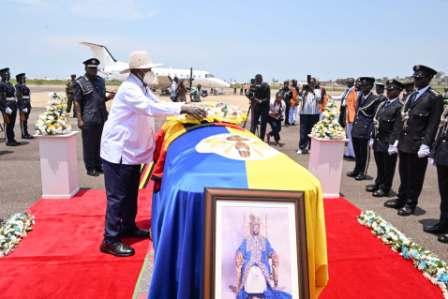
At exactly 12:00 noon on Friday, an aircraft touched down at the VIP Terminal of Entebbe International Airport carrying a king home for the last time.
President Yoweri Kaguta Museveni was there to receive him.
His Majesty King Oyo Nyimba Kabamba Iguru Rukidi IV had died days earlier while undergoing treatment abroad, and Friday’s ceremony marked the moment his body finally returned to Ugandan soil.
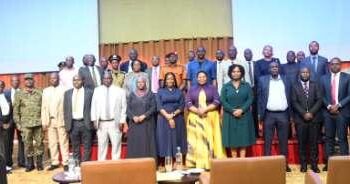
Gathered to witness it were members of the Tooro Royal Family, led by the Queen Mother, Best Kemigisa.
Tooro Kingdom officials stood alongside Central Government ministers and religious leaders.
Speaking after receiving the body and paying his last respects, President Museveni did not speak as a head of state addressing a foreign dignitary.
He spoke as someone who had watched the King grow up.
“We Looked After Him, We Took Him to School”
The President’s words carried the weight of three decades of history between himself and the Tooro throne.
“Sorry for the loss of the grandchild, King Oyo. We looked after him, we took him to school, and he grew up, but now the Lord has taken him,” President Museveni said.
That was not a figure of speech.
When the three-year-old Oyo was crowned in 1995 following his father’s sudden death, a regency was formed to raise and guide him until he came of age, and President Museveni was one of the four regents appointed to that role.
Friday’s ceremony, then, was not simply a president honouring a monarch.
It was, in a real sense, a guardian saying goodbye to the child he had helped raise into a king.
A Warning Delivered Mid-Campaign
President Museveni also used the moment to recall exactly how he learned that the King was gravely ill.
“The Queen Mother came and visited me in November 2025 during the campaigns ahead of the elections, and she told me about this problem of aggressive cancer that had started disturbing the King,” he said.
That timing is notable.
November 2025 sat at the height of campaigning ahead of Uganda’s January 2026 general election, a period when the President’s attention was consumed by a nationwide contest he would go on to win with more than 71 percent of the vote.
Even amid that campaign, the Queen Mother’s visit set in motion a private effort to save the King’s life that would run for the better part of a year.
Treatment That Could Not Save Him
President Museveni recounted what followed once the diagnosis reached him.
He said he subsequently supported efforts to secure specialised treatment for King Oyo, first in Germany and later in the United States.
That support was not offered quietly at a distance.
Government has since confirmed it covered the full cost of the King’s medical treatment abroad, as well as the cost of repatriating his remains from Dallas to Nairobi and on to Entebbe, paid personally by the President through State House.
Despite that effort, the outcome could not be changed.
“But they were unable to save the King,” President Museveni said.
He then offered his own summary of the reign that had just ended.
“During his entire leadership as King of Tooro, he was a very good person and leader. May the Lord grant him eternal rest. Amen,” he said.
Casket, Colours and a Guard of Honour
The ceremony that followed blended military precision with cultural symbolism.
Upon the aircraft’s arrival, President Museveni proceeded to the flagmast area, where the casket was formally received.
The Uganda Police then wrapped the casket in Uganda’s national colours alongside the colours of the Tooro Kingdom, binding state and kingdom together in a single gesture.
The casket was carried through a guard of honour mounted by the Uganda Police.
It was then placed at a designated point directly in front of the President.
President Museveni paid his final respects and laid a wreath as the Uganda Police Brass Band played solemn hymns.
Cabinet ministers, members of the Tooro Royal Family, Tooro Kingdom officials and religious leaders followed, each paying their own last respects.
A Quiet Moment Before the Journey Continued
After the public ceremony, the President stepped away from the cameras.
He held a brief meeting with selected members of the Royal Family, including the Queen Mother, at the Presidential Lounge.
It was a private pause before the next, longer leg of the King’s journey home.
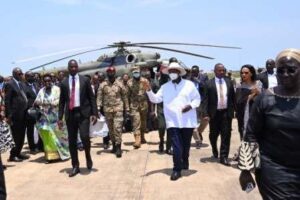
The delegation accompanying the body, together with selected members of the Royal Family, then boarded a helicopter bound for Kyegegwa District.
The Long Road Through Kyegegwa to Fort Portal
From Kyegegwa, the King’s final journey continues by road rather than by air.
The remains are set to be transferred from the airstrip directly into a hearse, with no public ceremony held at Kyegegwa itself.
From there, the procession passes through Kyaka County in Kyegegwa, Mwenge South County in Kyenjojo District and Burahya County in Kabarole District, covering more than 100 kilometres before reaching Fort Portal.
There will be no scheduled stops along the route, though the convoy is expected to slow through towns to let mourners catch a final glimpse of their King.
The remains are expected to arrive at Karuzika Royal Palace, the seat of Tooro Kingdom, by Friday evening, where a cultural reception led by the head of the Babiito clan will receive them.
A Coronation Anniversary Turned Burial Day
What happens next carries its own quiet symbolism.
King Oyo’s body will lie in state at Karuzika Palace from the day of arrival until September 12, allowing members of the public, dignitaries and well-wishers to pay their respects during nine days of official mourning.
September 12 is not an arbitrary date.
It was on that same date in 1995 that the three-year-old Oyo was formally enthroned as the 13th Omukama of Tooro, following his father’s death.
This year, September 12 would have marked the 31st anniversary of that coronation, a day the Tooro Kingdom’s own officials say the King had been looking forward to marking in person.
Instead, it will be the day he is laid to rest.
Nine Days Before Karambi
The funeral programme’s final day has already been mapped out in detail.
Mourners are expected to be seated by 8:00 a.m. at St John’s Cathedral in Fort Portal, with a church service beginning at 9:00 a.m. and concluding by around noon.
From the cathedral, mourners will accompany the body on foot to the Karambi Royal Tombs, also known as Amagasani, a journey organisers expect to take roughly two hours given anticipated crowds.
Burial rites are expected to conclude by around 2:00 p.m., in keeping with tradition that Tooro’s kings are not laid to rest in the evening.
The Uganda People’s Defence Forces are expected to fire a gun salute as part of the final honours.
For a King who ascended the throne before he could fully understand what a crown meant, and who spent his last months quietly undergoing treatment abroad rather than alarm the subjects who loved him,
Friday’s reception at Entebbe was only the midpoint of a journey that began decades ago in Fort Portal and will end there once more, on the very date it started.