













On Wednesday, 14th October 2026, a quiet forested campus along the Hoima road became the stage for a pointed national conversation about how Uganda intends to turn plans into prosperity.
At the National Leadership Institute (NALI) in Kyankwanzi, 250 senior military and civilian officers of Operation Wealth Creation (OWC) sat through a week-long capacity-building retreat.
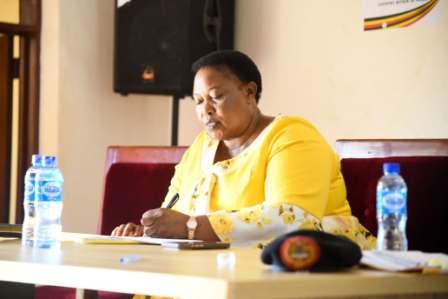
Hon. Babirye Milly Babalanda, the Minister for the Presidency and Member of Parliament for Budiope West Constituency, came to address them.

NALI is not a new setting for such gatherings.
The institute was established in 1985 and sits roughly 200 kilometres from Kampala.
It has since been used to mobilise leaders around values such as patriotism, integrity and professionalism.
Hon. Babalanda commended NALI’s leadership and the OWC Secretariat for organising the retreat.
She noted that it comes at a critical time for the country.
Uganda is now implementing the Fourth National Development Plan (NDP IV).
It is also pursuing the Tenfold Growth Strategy, which seeks to grow the economy to USD 500 billion by 2040.
The size of the national ambition
The numbers behind that target are daunting.
The Ministry of Finance says the strategy aims to lift the economy from about USD 50 billion in FY 2023/24 to USD 500 billion within 15 years.
Ministry of Finance technical advisor Moses Bekabye has explained that this means doubling GDP every five years.
Real GDP grew by 6.3 percent in the 2024/25 financial year, with agriculture, industry and services all contributing.
NDP IV’s five-year implementation is estimated to need Shs593.6 trillion, with 69.6 per cent expected from the public sector and 30.4 per cent from the private sector.
The Minister told the officers that the Strategy focuses on strategic investments in agro-industrialisation, tourism, mineral development including oil and gas, and science, technology and innovation.
She was candid that money and policy alone will not carry the country there.
“Achieving these ambitions requires more than economic policies and financial resources. It requires peace, security, accountability, efficient institutions and effective coordination across Government,” she said.
Why security and governance sit at the centre
Hon. Babalanda used the retreat to explain the role of the Governance and Security Programme (GSP).
She underscored its strategic role in anchoring Uganda’s socio-economic transformation, wealth creation and the Tenfold Growth Strategy.
The Programme’s goal, she said, is a peaceful and secure Uganda that adheres to the rule of law.
She explained that security, good governance, justice and accountability are not ends in themselves.
They are, in her words, essential foundations for investment, production, wealth creation and national prosperity.
The Programme is anchored in the Constitution, Vision 2040, NDP IV and Government development priorities.
It has nine strategic objectives.
These include strengthening security agencies.
They include improving the efficiency of justice, law and order services.
They include promoting transparency and anti-money laundering systems.
They include strengthening citizen participation in democratic processes.
They include enhancing implementation of the Bill of Rights.
They include promoting Uganda’s regional and international interests.
They include improving public policy analysis.
They include strengthening refugee protection and migration coordination.
They also include enhancing institutional capacity.
To make the link to everyday life plain, the Minister laid out what happens when the foundations crack.
“Insecurity discourages investment, corruption diverts resources, and inefficient institutions delay service delivery. Conversely, a secure environment and accountable leadership enable citizens and businesses to prosper,” she said.
Many institutions, one mission
Hon. Babalanda reminded the officers that GSP is not the work of a single office.
It brings together the Office of the President.
It brings together the Ministries of Defence and Veteran Affairs, Internal Affairs, Justice and Constitutional Affairs, and Foreign Affairs.
It brings together the Judiciary, the Uganda Police Force and the Uganda Prisons Service.
It also brings together intelligence and security agencies and other relevant institutions.
Each of these bodies has its own mandate.
Yet national challenges, she argued, demand collective action.
She stressed that coordination under GSP and OWC must produce tangible solutions.
“Coordination must produce solutions, not merely meetings. It must lead to clear responsibilities, timely action, proper follow-up and measurable improvements in the lives of Ugandans,” she said.
She urged OWC officers to familiarise themselves with the approved GSP planning, budgeting and implementation frameworks.
The aim is to identify where the programmes complement each other and to resolve service delivery challenges jointly.
Beyond input distribution
The Minister then turned to the core business of her audience.
OWC was established in July 2013 as a Presidential initiative to transform Ugandans from subsistence farming to commercial agriculture.
Its stated focus is raising household incomes and creating wealth by turning subsistence farmers into commercial farmers.
It followed a pilot programme that supported civilian veterans in the Luwero-Rwenzori Triangle.
Among its founding objectives are distributing production inputs equitably and on time, and helping smallholders grow into small-scale industrialists.
Hon. Babalanda told the officers that handing out inputs, on its own, cannot guarantee sustainable wealth creation.
“Farmers also require technical guidance, access to markets, reliable information, infrastructure and effective linkages with Government institutions. Your responsibility is to look beyond distribution and focus on viable enterprises, productivity, value addition and sustainable household incomes,” she said.
Her message echoes a concern that has followed the programme for years.
Farmers in several districts have complained of late, insufficient or poorly timed inputs, and of deliveries that ignore weather patterns.
She called for fair identification of beneficiaries.
She called for proper accountability for public resources.
She called for interventions that reach the people they were meant for.
In doing so, she said, officers contribute directly to NDP IV and the Tenfold Growth Strategy.
Five responsibilities for senior officers
The Minister challenged the senior officers to demonstrate professionalism, discipline, patriotism and responsible leadership.
She framed this around five key responsibilities.
The first is strengthening coordination with district and technical leaders.
The second is upholding accountability.
The third is promoting evidence-based implementation.
The fourth is engaging communities.
The fifth is upholding integrity.
She said reporting should go beyond the number of inputs distributed.
Reports, she said, should show results achieved in productivity, household incomes and enterprise sustainability.
The same thought was voiced recently inside OWC itself.
At a recent restructuring ceremony, OWC leaders cautioned against relying only on favourable reports and said assessments should rest on verifiable evidence and beneficiaries’ real experiences.
“No Corruption, No Sleeping”
Hon. Babalanda also reached for the language of public ethics.
“Public office is a responsibility, not a personal entitlement,” she said.
She was reaffirming Government’s commitment under the spirit of “Kisanja No Corruption, No Sleeping”.
Every officer, she said, must recognise that public resources are entrusted to them for the benefit of the people.
She added that institutions like NALI play a critical role in nurturing national values, ethical leadership and a shared understanding of Uganda’s development aspirations.
Counting what spending achieves
The Minister encouraged the use of digital systems and reliable reporting to track interventions.
Such tools, she said, would support evidence-based decisions.
“Monitoring must establish not only what Government has spent, but what expenditure has achieved,” she said.
This theme is not new in her public remarks on development finance.
At an earlier policy dialogue, she said Government cannot finance Uganda’s transformation through the national budget alone.
She spoke of widening the financing base through domestic savings, pension and insurance funds, and private capital.
Together, the two messages point in one direction.
Resources are limited, so every shilling spent must be traceable to a result.
Three questions to carry home
As the officers prepared to return to their areas of operation, the Minister left them with questions rather than instructions.
She asked them to consider: What can I do differently to improve service delivery?
She asked: Which coordination gaps can I help resolve?
And she asked: What measurable results should citizens expect?
Hon. Babalanda assured the officers of her commitment to work with OWC leadership and relevant institutions.
She pledged to strengthen coordination and improve service delivery.
A national mission, not a slogan
In closing, she tied the threads together.
“Governance, security and wealth creation are mutually reinforcing. Wealth creation is not merely a slogan; it is a national mission requiring integrity, coordination, innovation, resilience and people-centred leadership,” she said.
She ended on a political note.
“NRM is here to stay, we should serve Ugandans with purpose,” she added.
Due to other pressing official commitments, Hon. Babalanda formally closed the retreat ahead of schedule.
She wished the officers fruitful deliberations for the remaining sessions.
For the 250 officers still in Kyankwanzi, the test now moves from the lecture hall to the village.
Whether the farmer in a distant parish sees better advice, fairer access and stronger incomes will be the measure of what this week achieved.