
















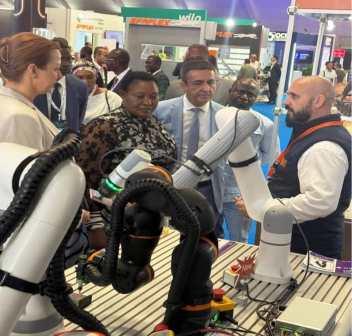
Casablanca this week hosted a gathering that organisers hope will change how Africa makes things.
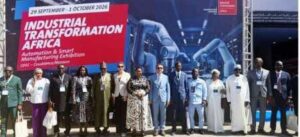
Industrial Transformation Africa (ITAF) 2026 ran from September 29 to October 1 at the OFEC venue in Casablanca, marking the debut of a major international industrial trade platform in Morocco.
It was organised by Hannover Fairs MENA and Deutsche Messe AG, and built around automation, artificial intelligence, robotics, smart manufacturing, intralogistics and energy systems.

The programme also included the Industrial Edge Summit and the Smart Factory Academy Casablanca, which focuses on practical knowledge transfer and industrial skills.
More than 5,000 industrial decision-makers were expected in the city for the first edition.
The forum brought together technology providers, industrial companies, investors, buyers and policymakers from North and Sub-Saharan Africa.
Their shared task was to find practical ways of modernising Africa’s production capacity.
Organisers said Morocco was chosen on purpose, because it links Europe, the Middle East and Africa as an industrial hub.
It was in this crowded hall that Uganda’s Minister for the Presidency, Hon. Babirye Milly Babalanda, took the floor on Wednesday.
Greetings from Kampala, and a Direct Appeal
The Minister opened by conveying warm greetings from President Yoweri Kaguta Museveni.
She also carried greetings from the First Lady and Minister of Education and Sports, Maama Janet Kataaha Museveni.
Those greetings went to the organisers, participants and stakeholders at the forum.
Then she turned to business.
Hon. Babalanda called for more investment, technology transfer and strategic partnerships.
Her aim was to speed up Uganda’s industrialisation and value-addition agenda.
She told delegates that Uganda is open to investors and technology partners.
The partners she wants are those who can turn Uganda’s abundant raw materials into higher-value products.
They would also expand local manufacturing, create jobs and drive technology-led economic change.
From Raw Exports to Finished Goods
At the heart of her message was a call for Africa to change course.
She said the continent must deliberately move away from exporting mostly unprocessed commodities.
In her view, Africa should turn towards value addition, manufacturing, and the production of finished and semi-finished goods.
She said this follows President Museveni’s vision for Uganda’s economic transformation.
“Value addition remains central to Uganda’s transformation,” Hon. Babalanda said.
“Processing agricultural and mineral resources locally and producing finished and semi-finished goods generates greater economic returns than exporting raw materials.”
The numbers behind her argument are easy to find at home.
Coffee exports in the 12 months to February 2025 reached US$1.72 billion, a rise of about 70 per cent, driven by demand, better prices and a push towards specialty coffee and premium packaging.
Analysts note that far greater value lies in roasting, packaging, branding and making finished products than in shipping raw beans.
Agriculture contributes about 24 per cent of GDP and employs more than 70 per cent of the population.
Industry, by contrast, contributes about 25.8 per cent of GDP while employing only 7.1 per cent of the workforce, and manufacturing alone accounts for about 16 per cent of GDP, according to World Bank figures cited in a trade portal.
That gap between output and jobs is part of why value addition matters so much to policymakers.
Where Uganda Sees Opportunity
The Minister listed the sectors she wants investors to look at.
They include agro-processing and agricultural value chains, coffee, pharmaceuticals and building materials.
They also include mineral beneficiation, oil and gas-related industries, machinery and equipment.
She added renewable energy, energy-efficient technologies, ICT and digital services.
She later widened the list to food processing, agricultural technologies, irrigation, storage and packaging.
Uganda’s emerging pharmaceutical industry is often cited as an example of local manufacturing that cuts imports while building higher-value skills.
Beyond crude oil exports, government is also pursuing downstream opportunities through a proposed refinery and petrochemical industries.
Capital Is Not Enough
Hon. Babalanda stressed that money alone will not build factories that last.
She encouraged investors and industrial partners to set up productive capacity and form long-term partnerships in Uganda.
Sustainable industrialisation, she said, needs technology, skills, innovation and knowledge transfer as well as capital.
She underscored the importance of industrial digitalisation, automation, mechanisation and modern production technologies.
These, she said, improve productivity, efficiency and competitiveness.
She added that such partnerships must come with skills development.
That way, Ugandan workers and enterprises can operate and maintain modern industrial systems and benefit from them.
Her message fitted the Casablanca agenda well.
An ITAF academy director said the aim is to build permanent bridges between ecosystems and make sure workforce skills match modern digital manufacturing standards.
Putting Tractors Before Factories
The Minister also turned to the farm.
She said Uganda must speed up agricultural mechanisation and move beyond largely traditional farming.
Higher productivity, she noted, strengthens agro-processing and raises household incomes.
It also gives manufacturers a reliable base of raw materials.
In plain terms, a factory that makes jam, flour or leather is only as good as the harvest that feeds it.

A Young Population as an Asset
Hon. Babalanda described Uganda’s young and growing population as an important economic asset.
She said it becomes one when matched with the right skills, productive jobs and industries able to create lasting opportunities.
She urged investors to consider Uganda’s growing domestic market.
She pointed to its strategic location in East Africa.
She also cited its rich agricultural and mineral resources, an expanding industrial base and its potential for value addition.
The Minister observed that ITAF is an important platform for engaging investors, technology providers and African partners.
Through it, Uganda hopes to identify practical opportunities for industrial cooperation, technology transfer and access to regional and continental markets.
The Bigger Picture: Vision 2040
Her pitch sits inside a much larger national ambition.
Under Vision 2040, Uganda aims to grow its economy from roughly US$50 billion today to US$500 billion by 2040.
The budget framework for 2026/27 also targets raising foreign direct investment inflows from about US$3.01 billion to US$50 billion by 2040.
It further seeks a bigger share of manufactured and medium-to-high-technology goods in exports.
Uganda’s exports totalled US$5.23 billion in the first half of 2025, and officials say that strong performance underlines the need for diversification and value addition.
The road is steep, and commentators have been candid about it.
Whether Uganda reaches the US$500 billion mark by 2040 remains uncertain.
A Call to Partners
Hon. Babalanda closed by reaffirming Uganda’s commitment to a modern, productive and competitive economy.
That economy, she said, will be built through industrial transformation.
Its focus is on attracting investment, technology, skills and manufacturing capacity.
The aim is to accelerate value addition, create jobs and strengthen local production.
It is also to deepen Uganda’s place in regional and continental value chains.
She called on investors, technology providers and industrial partners to explore the opportunities on offer.
She asked them to become partners in Uganda’s journey towards industrialisation, value addition and sustainable economic transformation.