
















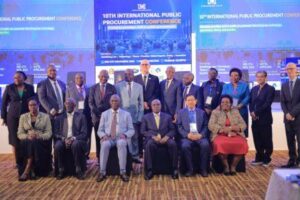
Kampala became a meeting point for the world’s procurement community on Tuesday, November 3, 2026.
Practitioners, researchers, policymakers and development partners gathered at Hotel Africana for the 10th International Public Procurement Conference (IPPC).
The conference runs from November 3 to 5. The theme was “Emerging Paradigm Shift in Public Procurement.”

The IPPC is a global network of procurement practitioners and researchers from more than 100 countries.
The Uganda Management Institute (UMI) and the Uganda Tourism Board won the bid to host on behalf of the Government of Uganda.
The conference was last held in Africa in 2018, in Arusha, Tanzania.
Delegates from different countries came to exchange academic ideas and examine the emerging trends and challenges in public procurement.
A Call to Move from Words to Work
Prime Minister Robinah Nabbanja used the occasion to challenge everyone in the room.
She asked governments, researchers, professionals, the private sector, civil society organisations and development partners to act on what they discuss.
Policies debated at international conferences, she said, must become concrete commitments and practical action.
She did not attend in person.
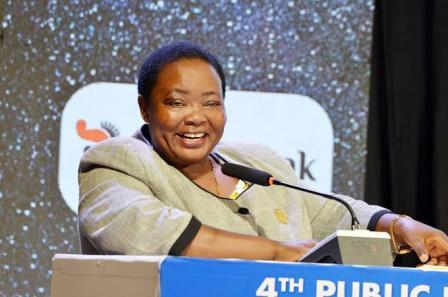
Her deputy, Dr Chrispus Kiyonga, delivered the speech on her behalf.
The speech stressed coherent policies, effective institutional coordination and disciplined implementation as the foundations of strong procurement systems.
“As Prime Minister of Uganda, I recognise the importance of coherent policies, effective institutional coordination and disciplined implementation. These principles are relevant to governments across the world,” she said.
Laws Alone Are Not Enough
Nabbanja was clear that good legislation is only the starting point.
Strong procurement systems, she noted, need more than sound legal frameworks.
They also depend on committed leadership and professional competence.
Effective oversight is another requirement.
So is the political will to act whenever standards are violated.
The point matters in Uganda, where procurement carries a great deal of public money.
Studies by the Ministry of Finance and the Public Procurement and Disposal of Public Assets Authority (PPDA) suggest that more than 60 percent of Uganda’s annual budget is spent through public procurement.
When so much of the budget passes through procurement, weak enforcement costs citizens directly.
Policy, People and the Age of Superintelligence
UMI Director Professor James L. Nkata opened a wider debate.
He said the conference had come at a time when the world is weighing the growing role of artificial intelligence (AI).
He also pointed to the possibility of superintelligence that could match or surpass human-level intelligence.
His message was that technology and economics must serve people.
Economic policies, he warned, risk failing when they ignore the needs of the people they are meant to help.
“Economics is meant to secure humans, and the day it appears not to do so, then that policy suffers a stillbirth,” he said.
He turned to political philosopher John Stuart Mill for support.
Mill argued that one of the most important qualities of any government is its ability to promote intelligence among its citizens.

Africa’s $535 Billion Question
Nkata then moved from philosophy to figures.
Public procurement across Africa accounts for roughly 17 per cent of the continent’s Gross Domestic Product (GDP).
He put that at about $535 billion.
He challenged delegates to ask how much of that spending stays in Africa.
He also asked how the continent can get the most benefit from it.
The question points to a debate about local suppliers, local jobs and local industry.
It asks whether African public money builds African economies or flows out to producers elsewhere.
Solutions from the Ground Up
Nkata urged stakeholders to address the practical challenges that affect procurement at every level.
Those challenges, he said, exist in the smallest institutions and the largest organisations.
They are found in developing and developed economies alike.
He wanted the discussions to produce workable solutions, not only academic papers.
Those solutions, he said, should improve procurement systems and strengthen accountability.
They should also make sure public resources deliver meaningful benefits to citizens.
Nabbanja and Nkata sent delegates the same message. Good policy is measured by what it does for ordinary people, not by how it reads on paper.