
















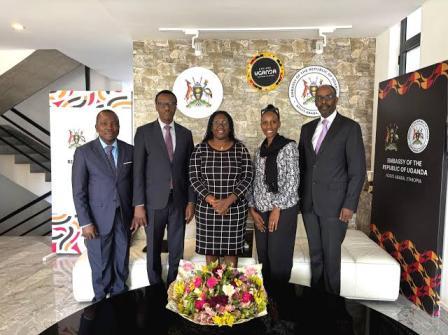
Inside the Uganda Embassy in Addis Ababa, a courtesy call turned into a conversation about the future of African coffee.
Mrs. Margaret Kafeero, the Chargé d’Affaires a.i., received Ambassador Solomon Rutega, Secretary-General of the Inter-African Coffee Organisation (IACO).
The meeting focused on IACO’s growing institutional footprint.

Its centrepiece was the opening of a new IACO office at the African Union (AU) headquarters in Addis Ababa.
The two officials also discussed the joint execution of a continental framework meant to transform the African coffee sector.
The Summit That Changed Coffee’s Status
Ambassador Rutega told the embassy that the ground has shifted since the 37th AU Summit in Addis Ababa.
That session of the Assembly of Heads of State and Government, held from 18th to 20th February 2024, unanimously adopted the Kampala Declaration.
The declaration put coffee into Agenda 2063 as a strategic commodity and named IACO a specialised agency of the African Union.
The Kampala Declaration was born at the G-25 Coffee Summit in Kampala, a gathering of Africa’s major coffee-producing nations.
IACO’s chairman at the time, Ethiopia’s Minister of Agriculture Girma Amente, called the decision a historic milestone for the sector.
For Ambassador Rutega, the policy shift is the start of something bigger.
“We are entering an era of aggressive restructuring to fundamentally alter global trade dynamics,” Ambassador Rutega stated during the meeting.
The Arithmetic of an Unfair Cup
The Secretary-General spoke plainly about who currently collects the money.
“While the global coffee sector generates over $465 billion annually, African producing countries currently receive less than $3 billion of that aggregate revenue. Elevating coffee to an AU strategic status directly tackles this disparity, and our new Addis Ababa Office at the African Union will serve as the strategic operational backbone to make this happen.”
The gap he described is the heart of the matter.
Africans grow the beans, but most of the profit is made further down the chain.
Most African coffee leaves the continent as unprocessed green beans, which captures minimal value and exposes farmers to volatile commodity prices.

From Raw Beans to Finished Products
A central pillar of the joint AU-IACO strategy is industrial value addition.
“We must shift decisively from exporting raw green coffee beans to locally processed, roasted, and packaged products,” Ambassador Rutega explained.
“Processing coffee domestically increases its economic value exponentially from roughly $2 per kilogram of raw beans up to $40 per kilogram of finished product, directly securing the economic livelihood of over 10 million households across Africa.”
He has long linked the sector to some 10 million households that depend on coffee for their livelihoods.
He has also said IACO’s focus is on investment in value-addition infrastructure, and that the continental free trade area must prepare affordable finance for small and medium coffee producers.
Uganda Says Yes
Mrs. Kafeero commended the IACO leadership and reaffirmed Uganda’s commitment to the initiative.
“Uganda fully embraces the opening of the new IACO office here in Addis Ababa, which will undoubtedly accelerate our regional trade ambitions under the African Continental Free Trade Area (AfCFTA),” Kafeero remarked.
“By leveraging an integrated 1.5 billion consumer market, we can successfully bypass traditional global supply chains that have historically disproportionately rewarded international brokers.”
Her point is that Africa could become a bigger buyer of its own coffee.
Uganda’s latest figures show Europe takes 62% of its coffee exports, against 21% for Africa and 12% for Asia.
The Two Giants of African Coffee
Mrs. Kafeero also highlighted the leadership roles of the continent’s major producers.
“Africa accounts for roughly 12% of worldwide production, heavily anchored by two dominant producers,” she said.
“Ethiopia stands as the biological birthplace of Arabica coffee, contributing roughly 39% of the continent’s output.”
“Side by side, Uganda stands proud as Africa’s premier exporter and rapidly growing producer specializing in high-yield Robusta, accounting for 23% of total production. Together, our nations are vital to steering this framework toward success.”
The figures show why Uganda has so much to gain.
Between April 2025 and March 2026, Uganda exported 8.8 million bags worth US$2.4 billion.
Coffee remains Uganda’s largest agricultural export and its leading source of foreign exchange.
Yet more than 98% of that coffee still leaves the country as green coffee.
Ugandan authorities have signalled a long-term shift toward roasted and soluble coffee.
Prices Add Urgency
Falling prices make the case for processing even stronger.
Uganda earned US$151.7 million from coffee exports in May, about 38% less than a year earlier.
Lower international prices and lower export volumes both weighed on that result.
A country that sells mostly raw beans takes whatever the world market offers.
Building the Machinery Around the Strategy
The new AU office is one part of a wider push.
Ethiopia has signed a host country agreement with IACO to establish the organisation’s first country office there and to host the 4th G-25 African Coffee Summit in Addis Ababa in 2027.
IACO and the African Union have also launched an Integrated African Coffee Sustainability Standard.
The standard is meant to help African producers meet the European Union’s deforestation rules on coffee imports.
A Shared Commitment
The meeting ended with both parties restating their commitment to work together.
They pledged to advance the objectives of AU Agenda 2063.
They promised to ensure fair economic returns for local farmers.
They also pledged to position Africa as a self-sustaining powerhouse in the global coffee industry.
The Uganda Embassy in Addis Ababa expressed strong support for IACO’s mission and for the opening of its AU-based office.