












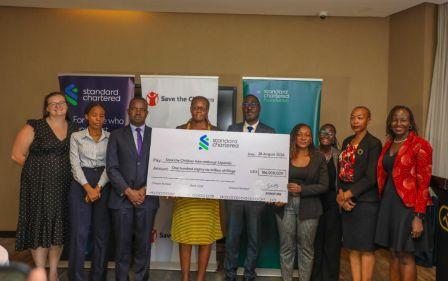
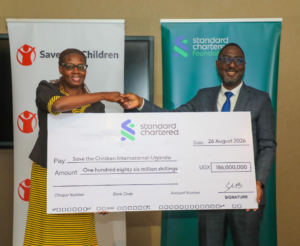
Standard Chartered Bank Uganda has donated US$50,000, equivalent to approximately Shs186 million, to Save the Children International–Uganda to strengthen Ebola prevention, community preparedness and the protection of children and families following Uganda’s declaration of being Ebola-free.
The contribution comes at a critical time when Uganda is seeking to preserve the gains made in containing the recent Ebola outbreak and strengthen its ability to detect and respond to future public-health threats.
The funds will support risk communication, community engagement, infection prevention and control, early detection and referral, community mobilisation and the dissemination of trusted health information.

The initiative is designed to ensure that children, families and frontline communities have the knowledge and tools needed to reduce their exposure to Ebola, recognise potential warning signs and seek appropriate care early.
The partnership also reflects the understanding that the consequences of an Ebola outbreak can extend far beyond illness and death.
Public-health emergencies can disrupt children’s education, family livelihoods, nutrition, protection and access to essential services.
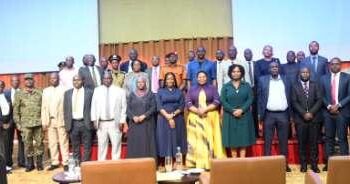
Speaking at the handover ceremony, Acting CEO of Standard Chartered Bank Uganda, Charles Katongole, commended the government, health workers, communities and development partners for their role in bringing the outbreak under control.
“We commend the Government of Uganda, the Ministry of Health, frontline health workers, communities and partners for the leadership that enabled Uganda to be declared Ebola-free.”
He warned, however, that ending an outbreak does not mean the country can afford to relax its preparedness.
“Protecting this achievement requires continued vigilance and preparedness.”
Katongole said the bank’s contribution would enable Save the Children Uganda to work directly with communities and government structures to strengthen prevention.
“Through this donation, we are supporting Save the Children Uganda to work with Government and communities to strengthen prevention and help keep children and families safe.”
A Contribution Beyond Emergency Response
Katongole said the donation forms part of Standard Chartered’s wider commitment to Uganda’s development.
“Today’s donation to Save the Children is another expression of our commitment to the national development agenda.”
“Beyond public health support, we remain focused on financing national priorities that improve lives and unlock opportunities.”
He said the bank had arranged financing for four government projects during the year valued at EUR752 million, approximately Shs3.27 trillion, covering power transmission, water and sanitation, critical roads and tourism-linked infrastructure.
According to Katongole, these investments, together with the bank’s community programmes, are intended to contribute to Uganda’s Ten-Fold Growth Agenda by supporting healthier, more resilient and productive communities.
Keeping Communities Alert After Ebola
The contribution will place considerable emphasis on community engagement because public-health officials have repeatedly stressed that communities are an essential part of outbreak detection and control.
People who understand how diseases spread are more likely to recognise potential risks and seek assistance promptly.
Trusted information can also help counter rumours, fear and misinformation, which can undermine public-health responses during an outbreak.
Save the Children Uganda says the partnership will help ensure that accurate information reaches children, families and frontline communities.
Acting Country Director Martha Ddambya welcomed the contribution, describing community preparedness as essential to maintaining Uganda’s Ebola-free status.
“We welcome Standard Chartered Bank Uganda’s support at this critical time.”
“Keeping Uganda Ebola-free requires sustained community engagement, trusted information, early detection and strong collaboration with Government and partners.”
Ddambya said the contribution would enable Save the Children to reach communities with information and support aimed at keeping children safe.
“This contribution will help us reach children, families and frontline communities with the knowledge and support they need to stay safe, while helping protect children’s ability to survive, learn and thrive.”
She emphasised that Ebola’s effects can continue long after the immediate medical threat has been contained.
“Ebola outbreaks can have impacts far beyond the immediate health threat, disrupting children’s education, protection, nutrition and access to essential services.”
She said Save the Children would continue working with government, communities and other partners to strengthen resilience against future emergencies.
Government Welcomes Private-Sector Partnership
The Ministry of Health also welcomed the partnership as an example of how government, humanitarian organisations and the private sector can work together to protect public health.
Dr Richard Mugahi, Commissioner of Reproductive and Child Health at the Ministry of Health, said such cooperation strengthens Uganda’s preparedness.
“Government welcomes partnerships that bring together public leadership, private-sector capability and humanitarian expertise to advance the public good.”
He thanked Standard Chartered and Save the Children for supporting national preparedness at a time when maintaining Uganda’s Ebola-free status remains a shared responsibility.
“We appreciate Standard Chartered Bank Uganda and Save the Children Uganda for stepping forward to support national preparedness and community protection.”
Mugahi said the collaboration would complement government efforts to strengthen health systems and protect communities.
“This collaboration complements Government’s efforts to safeguard children, families and frontline communities, while reinforcing the importance of resilient health systems, trusted information and collective action in protecting lives and livelihoods.”
Uganda’s Long Experience With Ebola
Uganda’s experience with Ebola stretches back several decades.
The country has developed substantial expertise in surveillance, laboratory diagnosis, infection prevention, case management and community mobilisation because of repeated outbreaks.
The latest outbreak once again demonstrated the importance of rapid detection and a coordinated national response.
Uganda’s ability to bring outbreaks under control has depended not only on hospitals and medical personnel but also on surveillance systems, laboratories, community health workers, local leaders and public awareness.
The latest intervention therefore seeks to strengthen precisely those areas that operate between major outbreaks.
Why Children Remain at the Centre
Children are particularly vulnerable during epidemics because their wellbeing depends heavily on adults and public systems.
When parents or caregivers become ill, children can lose access to food, education and protection.
When schools close or families lose income, the consequences can continue even after the health emergency has ended.
Children may also experience fear, stigma and disruption of their normal social lives.
Save the Children’s focus on community education and preparedness is therefore intended not simply to prevent disease transmission but also to protect children’s ability to continue learning and growing in safe environments.
Standard Chartered’s Long Presence in Uganda
Margaret Kigozi, Head of Corporate Affairs, Brand and Marketing at Standard Chartered Bank Uganda, said the Ebola contribution reflects the bank’s longstanding presence in the country.
“For 114 years, Standard Chartered Uganda has lived to its brand promise of being, Here for good for our clients, colleagues and communities.”
She said the bank had worked with Save the Children and other partners over the years to improve the welfare of Ugandans.
“This together with so many donations that we have made towards health causes, training young entrepreneurs and creating employment attests to our commitment to contribute to thriving communities.”
The partnership consequently places health preparedness within a broader corporate social responsibility programme that includes health, economic opportunity and community development.
Preparedness Must Continue After the Headlines Fade
Uganda’s declaration of being Ebola-free represents an important public-health achievement.
However, the end of an outbreak does not eliminate the possibility of future imported or locally transmitted cases.
Uganda’s geographical position and movement of people across borders mean that the country must continue investing in surveillance and preparedness.
That makes community awareness particularly important.
A health system can respond effectively only when people know where to report suspected cases and are willing to seek help without fear or stigma.
A Shared Responsibility
The Shs186 million contribution therefore carries significance beyond its monetary value.
It represents a partnership between a major private-sector institution, a humanitarian organisation and government health authorities.
Its immediate objective is to strengthen community protection against Ebola.
Its broader objective is to help Uganda build communities that are better prepared for future public-health emergencies.
The success of that effort will ultimately depend on whether information reaches the people who need it most.
It will depend on whether suspected cases are identified early.
It will depend on whether health facilities maintain strong infection-prevention practices.
And it will depend on whether communities trust and act on accurate health information.
As Uganda moves beyond the latest Ebola outbreak, the message from the partners is clear.
Being Ebola-free is an achievement worth celebrating, but remaining prepared is a responsibility that cannot be postponed.
The partnership between Standard Chartered Bank Uganda and Save the Children Uganda is intended to help ensure that Uganda is not only responding to outbreaks when they occur, but is better prepared to prevent, detect and contain them.
Together, for an Ebola-free and more resilient Uganda.