









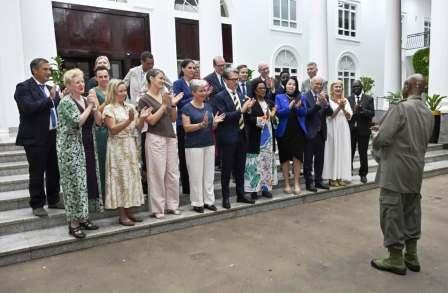
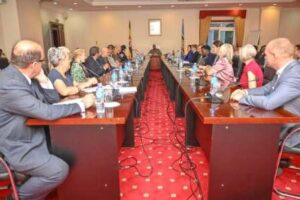
At State House Entebbe, President Yoweri Kaguta Museveni had a straightforward message for a room of European Union ambassadors and investors.
Uganda, he said, is ready for European capital.
He urged them to look at infrastructure, energy, manufacturing and agriculture.
In his view, putting money into productive sectors is how markets grow, jobs appear and an economy transforms.
He pointed to Africa’s fast-growing population as the reason Europe should pay attention.
“This is what we have been advising our European friends to look at, because Africa is a big potential market with its fast-growing population,” he said.
The pitch fits a long-running theme.
At an earlier meeting with EU envoys, Museveni thanked European countries for stressing trade over aid.
He noted that Uganda’s earnings from trade with the EU had tripled the aid it received.
The EU is Uganda’s biggest trading partner outside Africa.
On 2 July 2026, he made a similar appeal to British and European investors when he met the UK’s Baroness Chapman at the same State House.
Why Some African Countries Stumble
Museveni also explained why, in his view, some African countries have struggled to attract and keep investment.
He blamed instability partly on identity-based politics, including tribalism, religious divisions and ideological misunderstandings.
He added that these countries often fail to appreciate what the private sector contributes to economic growth.
Uganda, he said, has learnt from those mistakes.
He stressed that a stable political and economic environment is what allows private businesses to invest, expand production and create jobs.
“Music to My Ears”
The President welcomed the European projects already under way and those still being proposed.
He singled out infrastructure and other productive sectors.
Such projects, he said, would strengthen the economic links between Uganda and the European market.
“All these projects are music to my ears. By constructing these projects here, you are linking the market of Uganda to that of Europe. Why can’t anyone see that?” he asked.
Some of that European money is already at work.
By 2023, the European Investment Bank’s overseas arm had put more than €498 million into 31 projects in Uganda.
Those projects covered energy, water, transport, telecoms, industry and agriculture, among other sectors.
Under the EU’s Global Gateway strategy, eight further initiatives worth over €200 million were launched at the Uganda-EU Business Forum.
They target small businesses, women entrepreneurs, agribusinesses and digital infrastructure.
The Power Question
On energy, Museveni made a point that manufacturers will recognise.
The cost of electricity, he said, decides whether Uganda’s factories can compete.
He welcomed private investment in hydropower generation.
He also called for closer attention to electricity tariffs.
Affordable power, he argued, is essential for industrial expansion and economic growth.
He named three priorities for strengthening manufacturing: cheap electricity, railway transport and accessible financing for productive investments.
Europe is already involved in the sector, with Global Gateway supporting the refurbishment of hydropower turbines operated by the Uganda Energy Generation Company Limited.
Money, Rails and Roads
On financing, the President pointed to the Uganda Development Bank.
He explained that the government kept the institution to back investments that can expand production and create jobs.
He also asked the European Investment Bank to direct more funding into strategic infrastructure.
He listed railway development, electricity generation and distribution, and selected road projects.
On roads, he encouraged European investors to look at construction and financing models, including tolling where appropriate.
Jobs First, Taxes Later
Museveni reaffirmed the government’s support for tax incentives to attract investors, especially in manufacturing.
He stressed that eligible businesses should be able to enjoy a 10-year tax holiday.
Under Uganda Investment Authority guidance, a 10-year holiday is available to exporters of finished consumer and capital goods who sell 80 per cent of their output abroad.
The same period applies to investors in processing, manufacturing and assembly of listed items who commit at least US$10 million if foreign, or US$1 million if local.
His reasoning is that government revenue will follow the jobs.
“We are not interested in direct tax. What we want from you is jobs and production, and I will get taxes indirectly through consumer tax and income tax,” President Museveni said.
He said incentives should go to productive enterprises that create employment and widen the country’s economic base.
The government’s priority, he added, is for investors to set up businesses, raise production and employ Ugandans.
The resulting economic activity would also bring in public revenue through indirect taxes.
Uganda also allows 100 per cent foreign ownership.
Foreign investors can register and get licensed through a One-Stop Centre at the Uganda Investment Authority.
Uganda’s membership of the East African Community customs union gives access to about 177 million people.
Its membership of the COMESA free trade area extends that reach to about 500 million.
From Maize Fields to Fish Ponds
Museveni also turned to agriculture, irrigation, fish farming and agro-processing.
Uganda, he said, has abundant raw materials that could support industry and add value to what farmers grow.
He gave maize and soya beans as examples of local produce that could feed animal-feed factories and other processing industries.
He called for more investment in agricultural processing so that local raw materials are used better.
That, he said, would strengthen livestock production and widen market opportunities for farmers.
He added that the government is preparing to expand irrigation and fish farming.
The aim is to raise productivity and household incomes.
It would also give communities living near environmentally sensitive wetlands another way to earn a living.
In earlier engagements with Italian investors, he likewise urged factories that add value to Uganda’s coffee.
Protecting the Pearl’s Water
The President also welcomed investments that address environmental challenges linked to oil development.
He stressed the need to safeguard Uganda’s freshwater resources.
He noted that environmental sustainability is closely tied to protecting forests and other natural resources.
What Investors Say They Need
Not every European investor has been won over, and the obstacles are known.
At an earlier State House meeting, the German ambassador said investors were willing but were put off by the complications of acquiring land.
The Uganda Investment Authority says it can help with joint-venture partnerships and with acquiring land in industrial parks.
A Market Waiting for Partners
The meeting gave Uganda a platform to set out its investment priorities.
It also pressed the case for European capital, technology and business partnerships in the country’s economic transformation.
Whether Europe takes up the invitation will depend on power tariffs, financing and land.
Museveni’s message was that the door is open, the incentives are on the table and the market is growing.