











By Friday morning, an aircraft carrying the remains of a monarch will touch down at Entebbe International Airport.
For a week, that moment has been the fixed point around which an entire arm of the Ugandan government has organised itself.
The Minister for the Presidency, Hon. Babirye Milly Babalanda, laid out just how extensive that organisation has become.

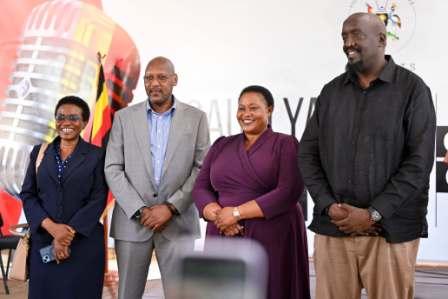
Addressing the press on Thursday, 3rd September 2026, at the Uganda Media Centre in Kampala, she gave a detailed update on the official burial arrangements for His Royal Highness Rukirabasaija Omukama Oyo Nyimba Kabamba Iguru Rukidi IV.
The King died on Friday, 28th August 2026, in Dallas, USA.
“Fellow Country Men and Women, as you may recall the Country on Friday 28th August 2026 received the sombre news on the passing away of a young, iconic, promising and people oriented Monarch,” Babalanda said.
A Week Government Spent in Mourning and Motion
Minister Babalanda walked journalists through exactly what government had done in the days since that news broke.
She said government, under the leadership of President Yoweri Kaguta Museveni, had taken up the moment and organised a series of actions to guide Ugandans and well-wishers through the mourning period.
She revealed that Cabinet had sat at State House Entebbe on Monday, 31st August 2026, under the President’s chairmanship.
There, she said, ministers extended long and earnest eulogies to the fallen monarch.
Cabinet directed the Rt. Hon. Prime Minister to coordinate a Whole-of-Government approach, drawing in the public sector and other critical stakeholders.
The following day, Tuesday, 1st September, Parliament received a statement from the Prime Minister.
Parliament then dedicated its entire sitting to debating and eulogising the late King’s contribution to Tooro’s socio-economic transformation.
While that parliamentary tribute was underway, Babalanda said, the Prime Minister was chairing a parallel meeting.
That meeting brought together an Inter-Ministerial National Organising Committee alongside representatives of the Royal Family and the Ministers for Gender and Culture, the Presidency, Agriculture, Tourism, Public Service, Foreign Affairs and Internal Affairs.
Why the Remains Are Arriving a Day Later Than First Planned
According to Babalanda, that Organising Committee meeting produced an important update.
Cabinet had already received a paper from the Ministry of Gender, Labour and Social Development detailing arrangements agreed with Tooro Kingdom.
Working with hospital authorities in Dallas, the Kingdom had tentatively set Thursday, 3rd September, as the date for the remains to arrive home.
That date has since shifted.
The remains will now be received at Entebbe International Airport on Friday, 4th September 2026, at 10:00 a.m.
Babalanda said government intends to handle the burial in unison, drawing a direct comparison to precedent.
“Government will handle the burial in unison as was done for the late Emorimori of Teso,” she said.
That reference points to Olem Osuban Adugala, the Emorimor of Teso, who died in February 2022 and was granted a state-supported burial that President Museveni personally attended, cautioning at the time against cultural institutions overstepping into political territory while praising their role in national unity.
Five Venues, One National Farewell
The scale of the logistics Babalanda described is unusual even by the standards of Uganda’s past state funerals.
She listed events management as covering five separate venues.
The first is Entebbe Airport, where the remains will be received.
The second is Karuzika Royal Palace, the seat of the Tooro Kingdom, which will host mourners in Tooro itself.
The third is Buziga Royal Residency, which will host mourners in Kampala.
The fourth is Karambi Royal Tombs, the traditional burial ground for Tooro’s monarchs, which will serve as the final resting place.
The fifth is St. John’s Cathedral, where a church service will be held.
Babalanda said government has provided tents, chairs, mobile toilets, cleaning teams and public address systems across these sites.
Feeding a Nation in Mourning
Hosting mourners across five venues for over a week required its own logistics chain.
Babalanda said food would be provided for mourners for nine days.
That feeding operation, she said, is being run by the Office of the Chief of Defence Forces under the Ministry of Defence and Veteran Affairs.
The meals will be served at both Buziga and Karuzika, the two residences expected to draw the largest gatherings of mourners in Kampala and Tooro respectively.
The Machinery Behind a Royal Funeral
Beyond tents and meals, Babalanda detailed the specialised funeral services government has engaged.
Funeral management, she said, is being handled by A-Plus Funeral Home.
Their responsibilities span airport reception, the hire of executive funeral vehicles from Nairobi, portraits, condolence books and casket wreaths.
They are also responsible for the order of service, the construction of a marble grave, and work on the Royal Mausoleum.
Babalanda said all of these costs are being covered by government.
She added that the Ministry of Health has separately arranged a health camp to attend to simple ailments among mourners gathered in Tooro during the mourning period.
Palace Upgrades and a Military Presence
Ahead of the burial, work has also been underway at the Kingdom’s own seat of power.
Babalanda said Karuzika Palace is receiving upgrades carried out by the UPDF Engineers Brigade.
On the day itself, security and protocol will fall to Uganda’s uniformed forces.
She said the UPDF and Uganda Police Force bands, pall bearers and a gun salute would form part of the ceremony.
Crowd control and counter-terrorism measures are also being coordinated by security agencies, she said.
Babalanda confirmed that security agencies have already taken charge of securing both mourners and property at the various venues.
Welcoming the Region’s Royalty
A funeral of this scale draws attention well beyond Uganda’s borders.
Babalanda said government has prepared protocol arrangements for delegations expected from royal families both within Uganda and across Africa.
She also disclosed that the Ministry of Foreign Affairs is in close contact with Kenyan authorities.
That coordination is meant to ensure the smooth transit of the King’s remains, which are travelling from Dallas through Nairobi before reaching Entebbe.
Who Is Footing the Bill
Perhaps the most striking detail in Babalanda’s briefing concerned the cost of bringing the King home.
She said government has met all medical bills accrued during the King’s treatment in Dallas.
She said government has also covered the full cost of repatriating his remains from Dallas to Nairobi and on to Entebbe.
Those costs, she said, were paid by the President personally through State House.
Closing a Chapter, Opening a Send-Off
Minister Babalanda closed her briefing by acknowledging the scale of coordination the moment has demanded.
She commended President Museveni, the Prime Minister and her fellow ministers for ensuring what she described as a coordinated government response.
With the remains due at Entebbe on Friday morning, the coming nine days will carry Uganda through a sequence of mourning rites rarely seen outside of a head of state’s funeral.
From the tarmac at Entebbe to the royal tombs at Karambi, the country is being asked to receive not just a king’s body, but the closing chapter of a reign that began when he was three years old and ended, three decades later, with an entire government machinery mobilised to send him home.